Tracks like this one were its capstone curriculum. This page stays up because the method it describes is still how we work. What is running right now is founder-led college readiness coaching. If you are not sure what fits, tell us the situation and a person will route it.
Pre-Engineering Track · Inaugural Summer 2028
Senior engineer-led · Co-taught by working professionals · Selective admissions
Build the engineering AI agent the next generation of mechanical, electrical, and biomedical engineers will keep open during their first design review.
Capstone agent · Build hardware AI. I built an AI agent that suggests CAD revisions based on tolerance constraints.
An agentic system that takes an engineering drawing, reasons about tolerances and material specifications, suggests revisions for manufacturability, and produces a design-review memo a junior engineer can present to their team lead.
Claude APIModel Context Protocol (MCP)OpenSCAD or FreeCAD CLIpgvector (spec library)Vercel deploy
The CAD-revision agent
Pre-Engineering capstone · illustrative run
Working
Ingests a CAD drawing or parametric model and parses dimensions, tolerances, and materials
Cross-references manufacturing constraints — tolerance stack-up, material yield, machining feasibility
Suggests revisions with reasoning grounded in design-for-manufacturability principles
Surfaces edge-case failure modes from a curated spec library
Generates a design-review memo with a prioritized revision list
Logs an audit trail of every reasoning step for the team lead's review
Illustrative run — this is the working agent your child builds, step by step, and ships to a personal URL.
Representative profile · mentor announced pre-season
Co-Teaching Faculty
Practicing engineer archetype (sample profile)
Recruiting from · the McCormick School of Engineering network
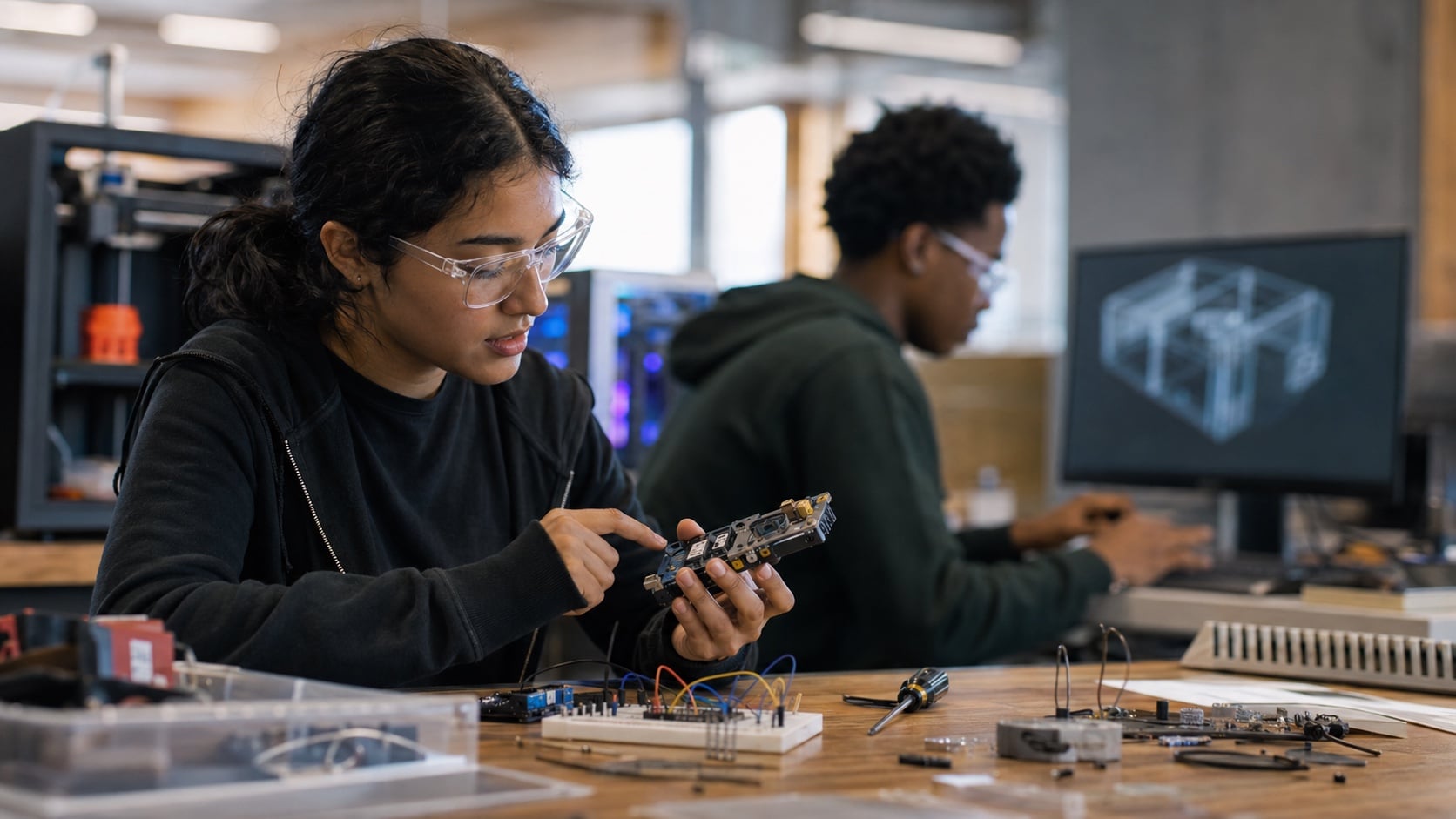
Our pre-engineering track will be co-taught by a practicing engineer — recruited from McCormick School of Engineering and the broader hardware and systems engineering ecosystem — alongside a senior software engineer. Your child works directly with an engineer who has shipped physical products and who can articulate the difference between a clever simulation and a manufacturable design. The mentor relationship continues past the program: pre-engineering students who perform well receive a personal letter of recommendation and direct introductions into the broader practitioner network.
What students leave understanding
Students leave understanding the difference between a design that runs in CAD and a design that survives a manufacturing review.
Curriculum Deep-Dive
Week 2 — Engineering AI deep-dive
The pre-engineering cohort splits off from the shared Week 1 foundations and works directly with the engineer on tolerance reasoning, manufacturability, and the design-review patterns unique to hardware AI.
01CAD parsing and parametric model ingestion — turning drawings into structured data
02Tolerance stack-up reasoning — propagating dimensional variance through assemblies
04Failure-mode retrieval from a curated spec library
05Hands-on architecture review with the engineer: where AI accelerates, where it must defer to human judgment
06Capstone scoping: pick a real mechanical or electronics design, write the spec, agree on an evaluation rubric
Week 1 foundations are shared across all 5 tracksWeek 3 builds + admissions coaching
Sample student work
What your child could build.
Sample capstone projects illustrating the scope of Pre-Engineering work. Inaugural cohort is Summer 2028 — these are not real-alumni outcomes.
Sample capstone spec — scoped for a rising 12th grader
Tolerance stack-up review agent for a 3D-printed assembly
Built an agent that reviews a multi-part 3D-printed assembly, propagates dimensional tolerances through the stack, and surfaces interferences before the print job runs.
Claude + OpenSCAD CLI + pgvector + Streamlit
Sample capstone spec — scoped for a rising 11th grader
Material-substitution recommender for a mechanical part
Built an agent that takes a part spec and proposes alternative materials with revised tolerances and cost implications, citing yield strength and machinability data.
Claude + LangGraph + Postgres + Next.js
Why this track wins for admissions
A capstone an admissions reader can verify.
An admissions reader at a top pre-engineering university — MIT, Stanford, Caltech, Berkeley EECS, Carnegie Mellon, Northwestern McCormick — is looking for the rare applicant who has built something real and can talk about the engineering judgment behind it. Most strong pre-engineering applicants present FIRST Robotics seasons, science-fair projects, and AP Physics scores — all important, all common. Far fewer can sit across from an interviewer and discuss the design tradeoffs in tolerance stack-up automation, the limits of simulation, or what a manufacturing review actually evaluates. Your child finishes the program with a working CAD-revision agent at a personal URL, an architecture writeup an admissions reader can verify, and a Common App essay built around the project — a piece of writing that makes their interest in engineering specific, hands-on, and verifiably their own.
— Jinwoong “Peter” Lee, founder · UC Berkeley ’18 · 8 years of software at Amazon & Ring · 11 years in education · 80+ students placed at top universities
No. Week 1 builds AI literacy from scratch and Week 2 introduces the engineering concepts you need — parametric modeling basics, tolerance stack-up, design-for-manufacturability heuristics. Curiosity and a serious interest in building physical things matter far more than prior CAD time.
No. The pre-engineering track is explicit that an AI agent is a design-review accelerant — it surfaces tolerance issues, manufacturability concerns, and material substitutions for a human engineer to evaluate. Production sign-off remains with a credentialed engineer. We teach citation-grounded reasoning specifically because trustworthy engineering AI must remain auditable to the practitioner.
An engineer recruited from McCormick School of Engineering and the broader hardware and systems engineering ecosystem — someone who has shipped physical products and lived inside design reviews. The specific mentor for the 2028 inaugural cohort is announced as the season approaches.
Strong pre-engineering candidates at MIT, Stanford, and Berkeley differentiate themselves through hands-on judgment, not just contest scores. A working CAD-revision agent — with a written architecture and a design-review memo — is unusually concrete evidence of engineering taste. Week 3's admissions coaching turns the project into a Common App essay draft.
Pre-Engineering · Selective by design
Ready to give your child the hardware AI advantage?
This track belongs to the Summer Institute, which is planned for 2028 and is not enrolling; no application is being accepted yet. What is running now is founder-led college readiness coaching.